
About Forte
Grupa Forte S.A. manufactures ready-to-assemble furniture. In the published customer story, the company already has its own PIM. Its task was to prepare and distribute existing product information for different B2B and marketplace requirements.
In a nutshell
- Starting point: An existing PIM holds the product information.
- Bottleneck: Repeated manual mapping for different partner formats.
- Use of shopvibes: Product enrichment, channel-specific mapping and configured connections for data distribution.
- Reported outcome: Faster preparation and clearer workflows for several marketplaces.
The challenge: data is available, but partner output takes work
A well-populated PIM does not automatically answer every retail partner's requirements. Attributes, categories and formats need to be output appropriately for each partner. Before shopvibes, this mapping required recurring manual work at Forte. A growing number of marketplaces increased the workload.
The solution: connect the existing PIM with distribution
Forte supplements its PIM infrastructure with shopvibes. Source data is prepared for the partners, while enrichment and attribute assignments are managed centrally. Configured integrations then support output to the relevant channels.
The published story names Amazon, Wayfair, home24, Kaufland and Check24. These references describe the customer's use at that time. They establish neither a particular country nor identical transfer of every data type for every partner. The current Wayfair page explains today's target markets separately.
The traceable data flow is: existing PIM → preparation and partner mapping in shopvibes → configured output → checks in the partner process. The scope of product data, media and any other data is agreed per integration.
The outcome in the reported project
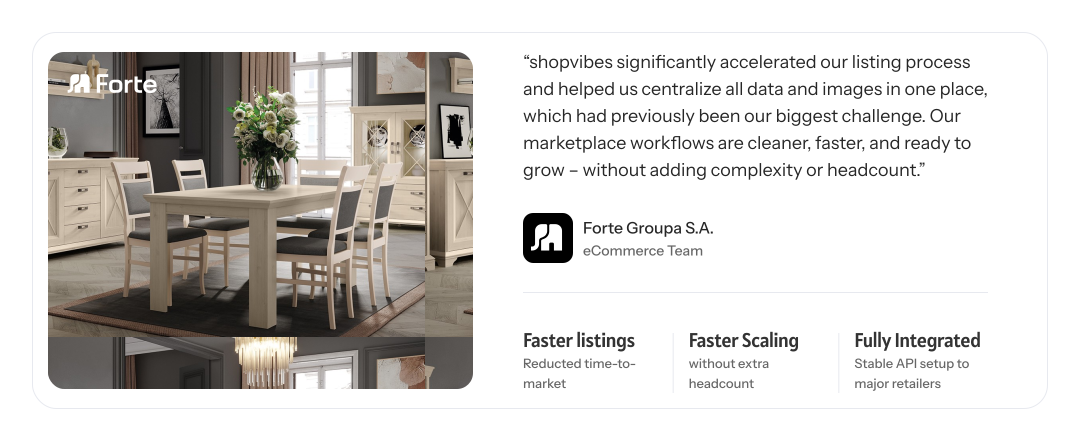
The existing customer publication reports shorter listing workflows and support for several marketplaces without enlarging the team. The Team Forte quote describes the perceived acceleration and improved overview. No new quantitative outcome measurement is added here.
For other companies, the process is the main transferable lesson: an existing PIM can remain in use while preparation for retail partners is added. Data acceptance and publication remain part of each partner's process.
What to check for your own range
Compare a real product family in your PIM with two current partner requirements. Which values are shared, which configurations differ, and which mappings are repeated manually today? The ERP and PIM comparison helps define system responsibilities; the template guide explains mapping.
For variant and dimension checks, see the guides to furniture configurations and sets and product dimensions and packages. These examples explain the approach and do not add claims about Forte's own data model.
Your next step
Bring your existing PIM and a partner template to a demo. We can discuss data sources, responsibilities and an appropriate test output.