
About Wolf Möbel
Wolf Möbel supplies solid wood furniture, including tables, chairs, sideboards and beds. It serves both physical and online retail partners. The published customer story describes a starting process in which product data was stored in the ERP.
The challenge: enrich information for retail partners
As retail partner requirements grew, Wolf Möbel needed to extend and improve its existing product information. In the ERP process described, maintaining this information was laborious or unavailable to the extent required. Missing data points were therefore added repeatedly for individual partners. This increased manual work and made consistent presentation harder.
This starting point describes the project reported in the customer story. It does not mean every ERP has the same limitations. What matters is the information actually maintained and the partner outputs required.
The solution: central enrichment and distribution
With shopvibes, Wolf Möbel manages and improves product information and images in a shared place. Additions no longer need to be maintained as separate records for every retail partner. Preparation for each partner's requirements takes place within the configured partner process.
The traceable workflow is: ERP-based source data → central enrichment of product information and media → partner-specific preparation → configured output and checks. Agree explicitly which data the ERP provides and who is responsible for information maintained in the supplementary product data process.
The customer story does not provide a complete technical interface specification or detailed field list. It therefore establishes neither a particular ERP connector nor additional price, stock or order functions.
The outcomes in the reported project
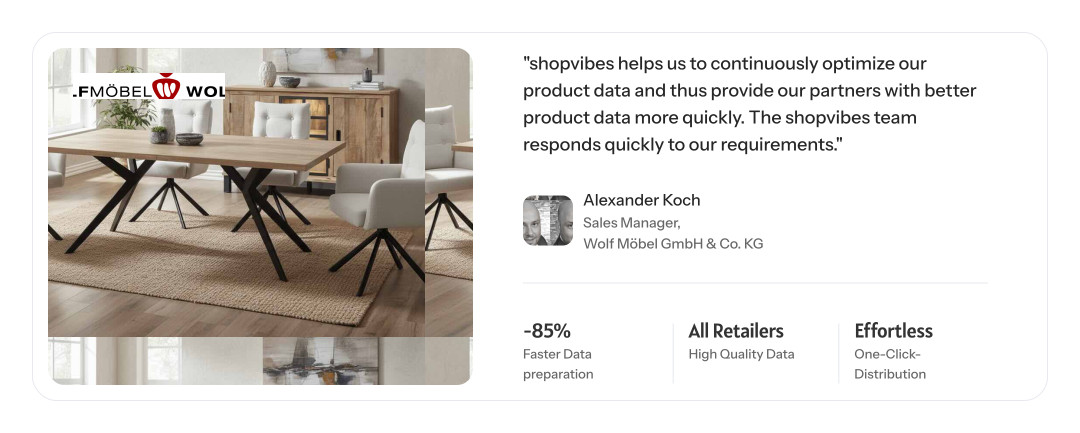
Wolf Möbel describes more consistent and efficient improvement of its product data. In the existing quote, Alexander Koch highlights continual improvement and the ability to provide information to partners more quickly.
The transferable strength lies in the data process: product information and images can be checked together instead of gathering missing details again for every partner. No new quantitative measurement or general time saving is inferred. Acceptance and publication still depend on the relevant retailer.
What your team can check
Choose a real furniture series and record which information is complete in the ERP. Then establish where images, dimensions, materials and included items are added and who approves changes. Compare a small test output with a retail partner's current template.
The ERP and PIM comparison helps define data responsibility. The guides to product dimensions and packages and variant images and image order provide concrete checks. These general examples supplement the story; they do not add properties to Wolf Möbel's data model.
The furniture solution shows how product maintenance and retailer output connect. Bring an ERP extract and a current retailer template to a demo to discuss your own data flow.